
The reshuffle in portfolios carried out by Prime Minister Manmohan Singh has apparently left some ministers unhappy, as some of them made their discontent clear through cynical remarks on Thursday. "I have forgotten that time (as a sports minister)...God has screwed my head in such a way that I can't look back and look forward." This is how M S Gill, who has been shunted out from the sports ministry to statistics and programme implementation, reacted.
Once seen as a spokesman of the government on internal security matters, Sriprakash Jaiswal was on Wednesday elevated to Cabinet rank and retained in the coal ministry. A three-time Lok Sabha member from Kanpur, Jaiswal's elevation to the Cabinet rank comes at a time when elections are scheduled in Uttar Pradesh, where he served as the state unit chief of the Congress. He has shed the portfolio of statistics and programme implementation.
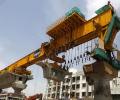
As many as 449 infrastructure projects, each worth Rs 150 crore or more, have been hit by cost overruns totalling more than Rs 4.29 lakh crore, according to a report. The ministry of statistics and programme implementation monitors infrastructure projects worth Rs 150 crore and above. Of the 1,736 such projects, 449 reported cost overruns and 547 were delayed.

India's urban unemployment rate declined in Q4FY23 to 6.8 per cent - the lowest in over four years -- after it stagnated at 7.2 per cent in the previous October-December quarter, reflecting improvement in the labour market, according to the Periodic Labour Force Survey (PLFS) released by the National Statistical Office (NSO) on Monday. The unemployment rate in current weekly status (CWS) terms for all ages in the March quarter was the lowest recorded in more than four years, from the time the NSO released India's first quarterly urban jobless rate for the December quarter in 2018. The jobless rate in urban areas had been on a continuous decline since the peak of 20.8 per cent in the April-June quarter of FY21.

The government on Monday admitted in Rajya Sabha that almost half of 951 central sector projects are delayed resulting in cost overrun to the tune of over Rs 40,000 crore (Rs 400 billion).

Factory production expanded by 1.7 per cent on an annual basis in February on account of improved performance by the mining and power generation sectors, as per government data released on Tuesday. The Index of Industrial Production (IIP) had contracted by 3.2 per cent in February 2021. The growth was 1.5 per cent in January 2022. As per the data released by the Ministry of Statistics and Programme Implementation, the growth in the mining sector was 4.5 per cent against a contraction of 4.4 per cent in February 2021.

From the Sensex pack, Reliance Industries fell the most by 2 per cent. Tata Steel, Bajaj Finserv, ITC, NTPC, Bharti Airtel, Tech Mahindra, Titan, Axis Bank and Bajaj Finance were among the other major laggards.
The government has said it is constantly working towards reviewing the improving the MPLAD scheme.

Growth rate in per capita income is projected to fall to the lowest in 21 years this financial year - except for the financial years 2019-20 (FY20) and 2020-21 (FY21) - according to the first advance estimates. During the last 21 years, the two periods - FY20 and FY21 - saw growth rates in per capita income lower than 7.9 per cent, seen during FY24. This was despite the real gross domestic product (GDP) being projected to grow by 7.3 per cent in the current financial year by the first advance estimates.

In May 2019, the food inflation was 1.83 per cent as per the full CPI data released for that period.

'The pace of disbursement and project recommendation picks up as the tenure of the House draws near and usually all amount is released.'
Powered by the high growth of the manufacturing sector, industrial growth touched 7.6 per cent during the first quarter of the current financial year as against 5.7 per cent during April-June, 2003.

Economies of Punjab, Andhra Pradesh, Madhya Pradesh, Uttarakhand and Haryana may have grown at a slower pace than the national economy during 2022-2023.

As many as 403 infrastructure projects, each worth Rs 150 crore or more, have been hit by cost overruns of over Rs 4.05 lakh crore owing to delays and other reasons, according to a report.

India's economic growth will be above 6 per cent in the current fiscal as the country has managed to strengthen its macroeconomic stability and performance even in a period of large global shocks, RBI Monetary Policy Committee (MPC) Member Ashima Goyal said on Monday. Goyal further said that a global slowdown reducing India's export growth, geopolitics fueling oil and food prices, and erratic weather are some of the continuing risks that the country faces. "India has managed to strengthen its macroeconomic stability and performance even in a period of large global shocks.
The per capita income of Indians continued its climb up the ladder, increasing 11.1 per cent in 2004-05 to Rs 23,308 (at current prices) compared to Rs 20,989 in 2003-04.

The findings of the report showed consumer spending falling for the first time in over four decades in 2017-18.
.jpg)
According to the latest data, until May, 48.3 per cent of the total 207 projects worth Rs 1,000 crore (Rs 10 billion) or above, also termed as mega projects, faced delays and witnessed a cost overrun of 19.2 per cent from the originally-sanctioned Rs 656,000 to Rs 781,000.
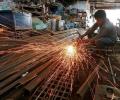
Industrial production contracted by 1.9 per cent in November, entering the negative territory after a two-month gap, mainly due to poor showing by manufacturing and mining sectors, official data showed on Tuesday. The manufacturing sector -- which constitutes 77.63 per cent of the index of industrial production (IIP) -- recorded a contraction of 1.7 per cent in November 2020, as per data released by the National Statistical Office (NSO). Mining sector output too witnessed a decline, shrinking 7.3 per cent.
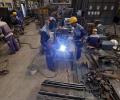
Industrial production growth entered positive territory after a gap of two months with a record 22.4 per cent rise in March this year, mainly due to the low-base effect and good show by manufacturing, mining and power sectors. The manufacturing sector -- which constitutes 77.63 per cent of the index of industrial production (IIP) -- grew by 25.8 per cent in March 2021, as per the data released by the National Statistical Office (NSO) on Wednesday. The mining sector output too grew 6.1 per cent in March, while power generation increased by 22.5 per cent.
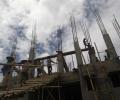
Delay in implementation of 224 central sector infrastructure projects resulted in cost overruns to the tune of Rs 2.11 lakh crore, government said.

The technical report of the NSSO has generated controversy following its observation that as much as 36 per cent units forming part of MCA-21 database, used in computing GDP, could not be either identifiable or traceable in the field.

The situation raises concerns about whether the promised freebies will once again push the state into a revenue deficit.
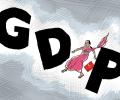
Though the ministry is considering 2017-18 as the new base year, no decision has been taken as the committees of experts are awaiting some more data before finalising their opinion.

Manufacturing sector production registered a decline of 17.1 per cent, while the output of mining and power fell 19.8 per cent and 10 per cent, respectively.

Sitharaman, who was holding the Commerce portfolio (Independent charge), was on Sunday promoted to the Cabinet rank as was Goyal.

The government clarified that the majority of industrial establishments had reported nil production, and cautioned that the numbers should not be compared with those of previous months. "It is not appropriate to compare the IIP of April 2020 with that of earlier months, and users may like to observe the changes in the IIP in the following months," said the ministry of statistics & programme implementation.

For the past one week, Modi has been holding in-person meetings with Union ministers apparently to take stock of the work done by the government in the last two years and to discuss various issues.

Industrial production surged by 13.6 per cent in June mainly due to a low-base effect and good performance by manufacturing, mining and power sectors but the output remained below the pre-pandemic level. The manufacturing sector, which constitutes 77.63 per cent of the Index of Industrial Production (IIP), grew by 13 per cent in June this year, according to the data released by the National Statistical Office (NSO) on Thursday. The mining sector output rose by 23.1 per cent in June while power generation increased by 8.3 per cent.
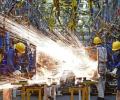
Industrial production declined by 10.4 per cent in July, mainly due to lower output of manufacturing, mining and power generation, as per the government data released on Friday.

The ministry of statistics and programme implementation on Friday released quick estimates of the Index of Industrial Production (IIP) which showed the index value at 88.4 in May against 53.6 in April, indicating a graded pickup in industrial activity. The index stood at 135.4 in May 2019.
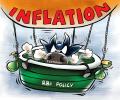
The RBI, which mainly factors in CPI for arriving at its bi-monthly monetary policy, has been mandated by the government to ensure that inflation remains at 4 per cent, with deviation of 2 per cent on either side.

The pace of retail price rise in January 2016 is the highest since 6.46 per cent in September 2014.

Rediff Labs shows the number of both domestic and foreign tourists visiting each state in 2015 and its growth rate.

The employment rate in the country declined marginally from 39.2 per cent to 38.6 per cent between 2009-10 and 2011-12, the Rajya Sabha was informed on Wednesday.

The Gross National Income (GNI) at 2011-12 prices is now estimated at Rs 112.13 trillion as against Rs 112.14 trillion estimated earlier for 2015-16.

'How low GDP would have been, we don't know.' 'It raises serious questions because so many indicators are pointing to such a sharp decline and GDP estimates are still showing 4 per cent growth.'

Leading indicators suggest economic activity has been disrupted after demonetisation.

'Revision of the base year for both CPI and GDP are long overdue.' 'The basic data that went into the 2011-2012 series were mainly from surveys done in 2011 or earlier.' 'We have since seen the emergence of new sectors like platform-based work and online marketing.' 'The employment surveys and the consumption surveys need to reflect these adequately.'
